








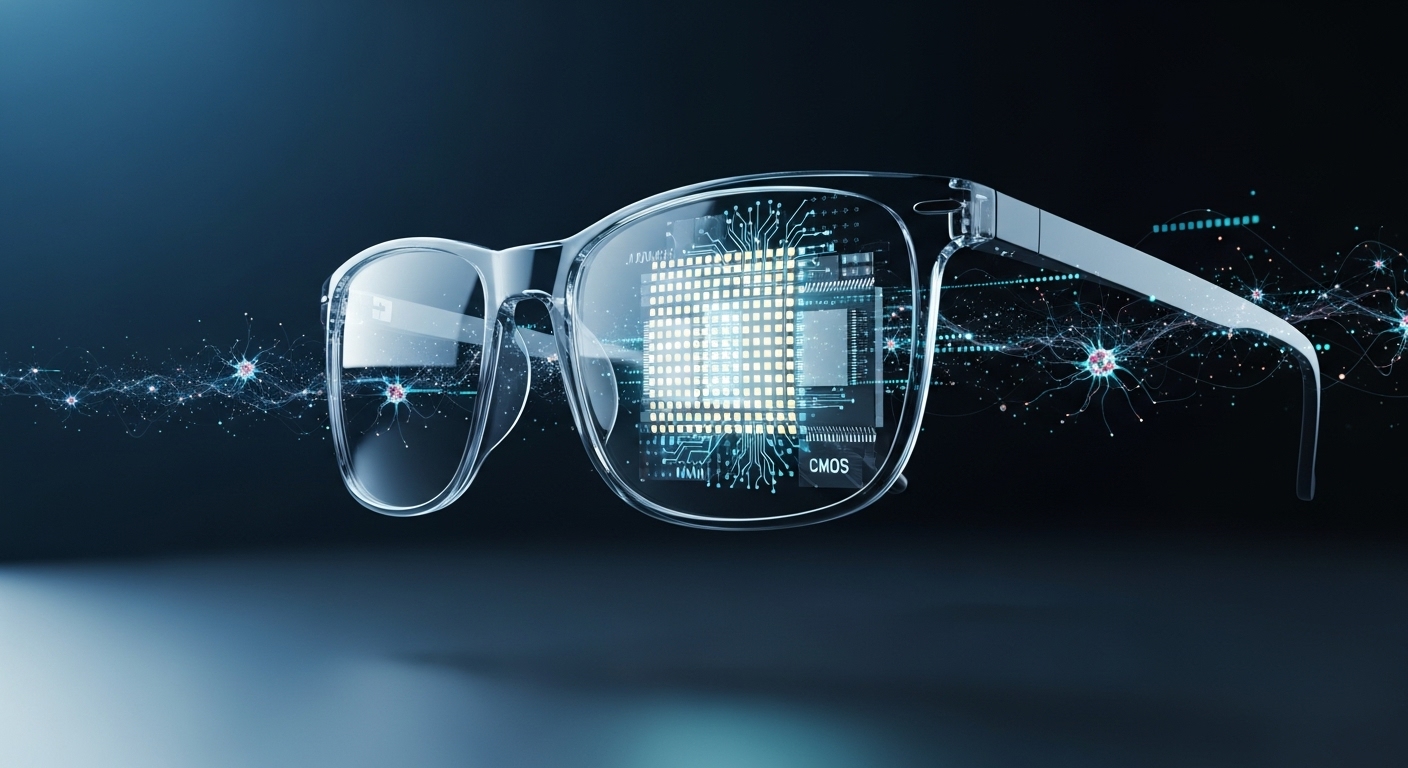
Imagine a world where your digital interactions are not confined to a smartphone screen, but seamlessly integrated into your visual field. Where information appears precisely when and where you need it, feeling less like a device and more like an extension of your natural perception.
This isn’t distant science fiction. The groundwork for this reality is being laid right now, often through partnerships that might seem purely technical on the surface, but carry profound implications for how we’ll live and work with artificial intelligence in the very near future.
A recent Memorandum of Understanding (MOU) between SEMIFIVE and SAPIEN Semiconductors, focused on developing next-generation micro-display ‘CMOS backplane’ technology, might sound like a niche announcement. Yet, from a strategic perspective, this collaboration could very well be one of the quiet but pivotal developments propelling the next wave of AI integration into our daily lives, particularly within the burgeoning wearable market.
The Unsung Hero: Why Micro-displays are Critical for AI’s Next Frontier
For AI to truly move beyond our phones and into our peripheral vision – into smart glasses, advanced augmented reality (AR) headsets, and even more sophisticated smartwatches – the display technology needs a radical leap. Current limitations in traditional display manufacturing and performance have been a significant bottleneck.
We’re talking about displays that need to be:
- Tiny: Fitting into sleek, comfortable form factors without bulk.
- Bright: Performing optimally in various lighting conditions, including direct sunlight.
- Power-Efficient: Ensuring long battery life, a perpetual challenge for wearables.
- High-Resolution: Delivering crisp, clear visuals without pixelation, crucial for immersive experiences and text readability.
- Fast: Responding instantly to user input and dynamic content.
Micro-LED technology promises to deliver on these fronts. These minuscule light-emitting diodes offer superior brightness, contrast, and efficiency compared to existing OLED or LCD panels. However, driving these thousands, or even millions, of tiny pixels requires a highly sophisticated control system: the CMOS backplane.
Decoding the ‘CMOS Backplane’: The Brain Behind the Pixels
Think of the CMOS backplane as the nervous system of a micro-display. It’s the silicon wafer that contains all the transistors and circuitry necessary to individually control each tiny micro-LED pixel. Without an advanced, well-designed CMOS backplane, micro-LEDs, no matter how tiny or efficient, simply can’t function effectively as a display.
This is where the SEMIFIVE and SAPIEN partnership becomes particularly compelling. SEMIFIVE brings its expertise in AI System-on-Chip (SoC) platforms, which are essentially highly integrated circuits that can handle complex AI computations and processing. SAPIEN Semiconductors, on the other hand, specializes in micro-LED display driver design, which is the intricate art of designing those very CMOS backplanes to optimally control micro-LEDs.
In practice, we often see brilliant innovations stalled by the sheer complexity of integrating disparate technologies. This MOU aims to bridge that gap, combining two critical pieces of the puzzle. It’s about creating a unified, optimized architecture where the AI processing (SEMIFIVE’s strength) can communicate seamlessly and efficiently with the display’s control system (SAPIEN’s strength), all within the tight power and space constraints of a wearable device.
Accelerating the AI Wearable Market: More Than Just Displays
A common observation among analysts is that the real potential of AI in wearables has yet to be fully unlocked. Current smartwatches offer notifications and basic health tracking. Early smart glasses have struggled with form factor, battery life, and display quality. Advanced AR still feels clunky.
This partnership is directly tackling some of the core technical hurdles that have held back these innovations:
-
Enabling True AI Immersion: For AI to provide genuinely useful, contextual information in your line of sight, it needs a display capable of rendering complex graphics, data overlays, and even real-time video feeds with pristine clarity and minimal latency. An advanced CMOS backplane for micro-LEDs is fundamental to achieving this. This move is about enabling a future where AI isn’t just an app on your phone, but an intelligent layer interacting with your environment via a display that feels almost invisible. To understand more about micro-LED technology, a deeper dive into its technical underpinnings is highly recommended.
-
Power Efficiency for “Always-On” Experiences: Wearables demand incredible power efficiency. The integration of SEMIFIVE’s AI SoC platform with SAPIEN’s optimized micro-LED driver design targets this directly. By designing these components to work together from the ground up, they can minimize power draw, leading to longer battery life – a critical factor for any wearable hoping for widespread adoption.
-
Strengthening the Value Chain: The description highlights “comprehensive collaboration from design to verification.” This integrated approach is crucial for accelerating commercialization. Fragmented development often leads to compatibility issues and delays. By working together closely, they can streamline the entire process, bringing robust, high-performance micro-display solutions to market faster.
-
Expanding Market Reach: While smart glasses and AR/VR headsets are obvious beneficiaries, the ripple effect could extend to various high-end wearable applications where compact, high-performance, and power-efficient displays are paramount. Think medical devices, industrial augmented reality tools, or even advanced automotive heads-up displays.
The Path Ahead: Realities and Opportunities
While the potential is clear, the path isn’t without its challenges. Developing cutting-edge semiconductor technology requires substantial investment, precise manufacturing, and rigorous testing. Successful integration will hinge on not just technical prowess but also effective project management and seamless communication between the two companies.
However, the timing of this collaboration couldn’t be more opportune. The global focus on AI, coupled with a growing consumer appetite for more discreet and powerful wearable technology, creates a fertile ground for such innovations. Companies that can deliver on the promise of truly immersive, power-efficient, and compact displays will be well-positioned to capture significant market share.
This partnership isn’t merely about developing a new component; it’s about enabling a future where the digital world becomes an intuitive overlay on our physical reality, driven by increasingly powerful and seamlessly integrated AI. It’s a quiet but significant step towards making truly intelligent, almost invisible, wearable computing a widespread reality.
Frequently Asked Questions About Micro-display CMOS Backplanes
What is a CMOS backplane in micro-displays?
A CMOS backplane is a silicon chip that contains the active circuitry (transistors and control logic) needed to individually address and drive each tiny pixel in a micro-LED display. It acts as the “brain” that controls the image projected.
Why is this technology important for AI wearables?
It enables displays that are extremely small, bright, high-resolution, and power-efficient – all critical requirements for sleek, long-lasting, and immersive smart glasses, AR headsets, and other AI-driven wearable devices.
What are the key benefits of the SEMIFIVE and SAPIEN partnership?
The collaboration aims to combine SEMIFIVE’s AI SoC expertise with SAPIEN’s micro-LED display driver design, accelerating the development and commercialization of advanced micro-display solutions. This strengthens the entire value chain from design to verification, leading to better-integrated and more efficient products.
What markets will this technology impact most?
The primary focus is the AI wearable market, including smart glasses, AR/VR headsets, and advanced smartwatches. However, its applications could extend to other areas requiring compact, high-performance displays, like medical devices or specialized industrial equipment.
What are the main challenges for this technology?
Challenges include the high cost of development and manufacturing, the complexity of integrating advanced AI processing with micro-display drivers, and ensuring manufacturability at scale while maintaining performance and power efficiency.
The Road Ahead: Building the Invisible Future
The collaboration between SEMIFIVE and SAPIEN Semiconductors on next-generation micro-display CMOS backplane technology is a prime example of how foundational component-level innovation quietly underpins revolutionary shifts in user experience. It’s not the AI itself, but the sophisticated, compact, and power-efficient display that will allow AI to truly manifest as a seamless, always-available assistant in our peripheral vision.
As we look towards a future increasingly augmented by AI, the success of partnerships like this will determine how quickly and effectively we can transition from interacting with our devices to having intelligent information and experiences woven effortlessly into our daily lives. The ‘CMOS backplane’ might remain unseen, but its impact on our AI-powered future will be anything but.